Disclaimer: BatchDialer is designed to support responsible outbound calling. However, users are responsible for complying with all applicable federal, state, and local laws, carrier requirements, and regulations, including the TCPA and Do Not Call (DNC) rules.
Key Takeaways
- Phone number reputation has a direct impact on answer rates, deliverability, and the overall success of outbound calling campaigns.
- Following best practices such as monitoring number health, limiting call volume, maintaining clean contact lists, and registering your caller identity can help reduce the likelihood of spam labeling.
- Combining responsible calling practices with tools like caller reputation monitoring, STIR/SHAKEN support, and BatchDialer Remediation helps businesses protect their caller reputation and maintain more consistent connection rates over time.
For businesses that rely on cold calling, phone number reputation monitoring can make or break your ability to connect with potential customers. Unfortunately, a lot of legitimate businesses are having their outbound calls erroneously flagged as spam calls. Or even worse, the calls are being blocked without ever ringing at all.
Thankfully, there are some cold calling tips that can help businesses maintain and even restore their phone number reputation. Ricky Fernandez of Caller ID Reputation recently joined us for a webinar to discuss how cold callers can navigate this landscape. He has some insights from his years of experience with cold calling and reputation management that will help you avoid the trap of getting flagged. He also shared what to do when it happens.
The repercussions of having a negative phone number reputation go beyond the unlikelihood of someone answering your call. When this issue persists, it eventually becomes a staffing issue. When sales agents are repeatedly stymied by having their calls erroneously labeled as scams, burnout and employee turnover inevitably follow.
You could be flagged and not know it
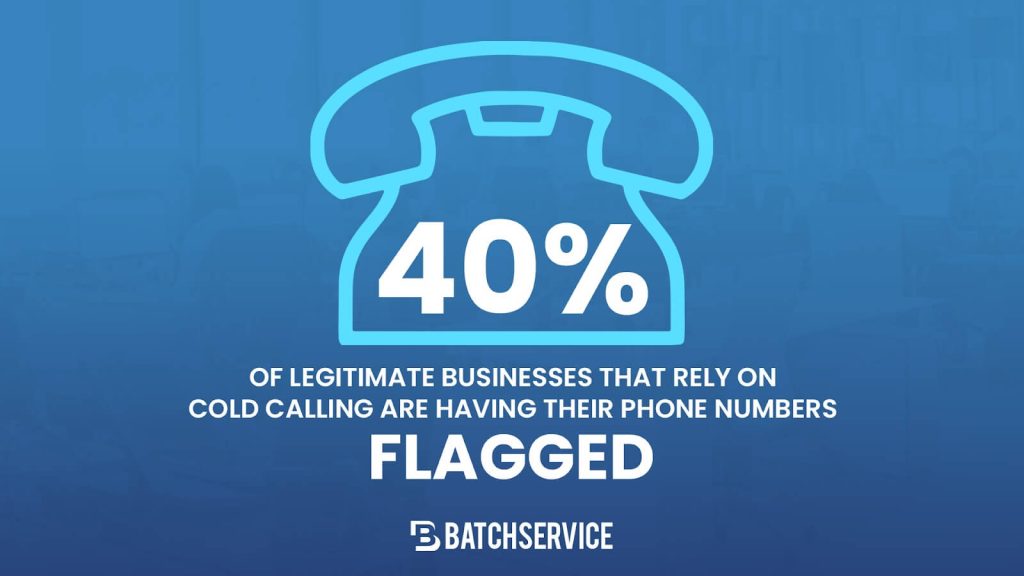
If you’ve been flagged for spam, you’re not alone. This issue is so pervasive that 40% of legitimate businesses that rely on cold calling are having their phone numbers flagged. This frequently happens without the businesses knowing that it’s occurring. A company could be wasting hundreds, or even thousands, of hours cold calling with flagged numbers.
Once a number has been flagged, it’s nearly impossible to market effectively. The number of people who pick up a call from an unfamiliar number grows smaller every year. According to Fernandez, only 27% percent of people will answer a call that is marked as “unknown,” while only 9% of people will answer a call marked “scam likely.”
This is especially discouraging because cold calling is such an effective tool. The conversion rates for cold calling surpass those of SMS messaging, email, and direct mail. In a survey of BatchService customers, cold calling was ranked as the number one tool that respondents said they plan on using to grow their business in the coming months.
Phone carriers’ response to scams
Actual telemarketing scams remain a serious problem, but phone carriers are struggling to keep up. With over 60 billion robocalls every year in the US alone, it’s difficult for carriers to distinguish between legitimate calls and scam phone calls. This is because scams are ever-changing, yet phone carriers have a fixed solution of simply flagging any numbers based on patterns they see.
Federal regulators have also stepped in to address this issue. Carriers and businesses that place high-volume outbound calls must comply with STIR/SHAKEN, a protocol that the FCC required starting in June 2021. The FCC and FTC enforce this with originating service providers in order to authenticate that calls are legitimate. STIR/SHAKEN has a ranking system of A, B, and C-level attestation.
An A-level attestation is the highest level and means the signing carrier has determined that the caller is authorized to use the calling number. All phone numbers provided by BatchDialer are A-level attestation.
B-level attestation indicates the signing carrier can authenticate the origin of the call, but cannot confirm that the caller is authorized to use the calling number.
C-level attestation means the signing carrier can authenticate the network from which the call was received, but not the origin or the calling number.
Tips For Cold Calling
Fortunately, businesses can protect their phone number reputation through some technology solutions and cold calling best practices.
Finding the right auto dialer for your business
If you’re working with auto dialer technology that’s effective for churning out numbers but is lacking when it comes to reputation protection, you’re going to be operating at a disadvantage. Here are some dialer-related tips for cold callers:
- Use a dialer with reputation flagging
The only thing worse than having your calls marked as spam is not knowing that’s how they’re appearing on caller ID. Only use a dialer that alerts you to caller ID flags so you can identify issues early.
Pro Tip: It’s also worth looking for proactive reputation tools. BatchDialer Remediation provides one-time business verification that helps establish your business as a legitimate caller across your current and future BatchDialer phone numbers, reducing the likelihood of spam labeling before it impacts your outreach.
- Maintain clean phone numbers
Is your dialer ensuring that the numbers you call are active? Are you certain that you’re not calling anyone on the do-not-call registry? This criterion is the most important issue for maintaining your phone’s reputation. On top of the damage to your reputation, calling someone on the do-not-call list can result in businesses being fined up to $43,792 per call.
- Sleep numbers that have spam flags
Knowing that you have a spam flag on one of your numbers is half the battle. Once you’re aware that a number has been flagged, stop using it immediately and find out why this happened.
- Keep a pool of clean numbers
Being able to swap out a flagged number for a clean one will allow you to keep making calls without missing a beat.
- Use a dialer that accepts callbacks
If your dialer doesn’t accept callbacks, you’re impeding your outreach strategy by not giving potential clients an opportunity to call you back. This is also a problem from a phone number reputation standpoint. Not accepting callbacks could get your number flagged because this is a common practice for scammers.
- Actively manage your phone numbers
Every day, you should schedule time to identify numbers with poor performance. Take bad numbers out of service for 30 days and identify why there was a performance issue. Once you’ve resolved the problem, then test them again to see if the issue persists.
- Use local numbers as much as possible
People are much more likely to respond to a call that’s coming from a nearby area code than one that’s across the country. BatchDialers will place the call from the closest area code to the recipient of the phone call.
Other Cold Calling Tips
In addition to having the right dialer functionality, here are some cold calling tips you can implement to protect your business reputation.
- Register your numbers with the phone carriers
To avoid getting your number flagged for spam or “scam likely,” it’s important to register your Calling Name Presentation (CNAM) data with each carrier. This is one of the best ways to get more favorable treatment from carriers.
- Ensure proper phone etiquette. Are you making sure that your callers are speaking properly to customers? Maintaining proper phone etiquette includes practices as basic as hiring callers who use proper grammar. It also includes making sure that callers aren’t using pressure tactics–or even worse, abusive language–when they connect with people.
- Don’t bombard people. Persistence is an asset for cold callers, but only up to a certain point. Fernandez says that the maximum number of times you should call someone is twice per day, once in the morning and once at night.
- Know your customer. Different types of customers will have different behaviors for responding to incoming calls. For example, if your target demographic is millennials, they’re more likely to let a call in the evening go to voicemail. On the other hand, if your target demographic is retirees, they’re more likely to answer a call in the evening.
While many businesses continue to be unfairly flagged, they also have access to solutions that maintain and repair their reputations. Scams are constantly changing, so it’s important that any reputation protection efforts are ongoing. “Nothing is absolutely foolproof,” Fernandez says, “so having a proactive monitoring service is absolutely necessary.”
Frequently Asked Questions
Why are my business calls being labeled as spam?
Calls may be labeled as spam when carriers detect calling patterns associated with robocalls or scams. High call volumes, repeated calls from the same number, poor caller reputation, or unverified business information can all contribute to spam labeling.
How can I improve my phone number reputation?
Start by following responsible calling practices, monitoring your number health, avoiding excessive call volumes, removing disconnected numbers from your lists, and honoring Do Not Call requests. Proactive business verification and caller reputation monitoring can also help reduce the likelihood of spam labeling.
What should I do if my phone number has been flagged?
If one of your numbers is flagged, stop using it temporarily and investigate the cause. Review your calling practices, check for any reputation issues, and allow the number to rest before returning it to your calling rotation if appropriate.
What is STIR/SHAKEN?
STIR/SHAKEN is an industry framework that helps carriers verify that a call is coming from an authorized source. Calls with higher attestation levels are generally viewed as more trustworthy, helping reduce spoofing and improve caller confidence.
Why is accepting callbacks important for outbound calling?
Allowing recipients to return missed calls helps establish legitimacy with both consumers and carriers. Businesses that don’t accept callbacks may appear less trustworthy because scammers often use numbers that cannot receive incoming calls.
What features should I look for in a cold calling dialer?
Look for features such as caller reputation monitoring, DNC scrubbing, local presence dialing, callback support, number health tracking, STIR/SHAKEN compliance, business verification, and reporting tools. These capabilities can help improve deliverability while supporting compliant and effective outbound calling.