
Get a summary of this article with your favorite AI:
Disclaimer: BatchDialer does not provide legal advice. This article is for informational purposes only. Before beginning a cold-calling campaign or using AI, we recommend researching applicable laws and seeking legal advice as needed.
| Quick Answer: AI is a powerful tool for outbound calling, but it can’t replace human agents. Use AI to handle the data-heavy work (researching prospects before calls and tracking outcomes after them), while leaving the actual conversation to skilled humans who can build trust and respond with empathy. |
With AI taking the world by storm, you may wonder if human call agents are even necessary anymore.
The truth is, something essential is lost when you outsource all of your prospecting conversations to AI. While AI can be a powerful tool to make you more productive, it can’t totally replace you. Read on to learn more about where and where not to use AI in your call workflows.
Key Takeaways:
- AI is best used before and after a cold call (for research and analysis). You shouldn’t have it hold the actual conversation with the prospect.
- Prospects respond better to real empathy and trust-building than to AI agents that simulate human conversation.
- The most effective dialing campaigns combine AI tools with skilled human agents rather than relying on either one alone.
The Strengths of AI in Outbound Calling
AI shines before and after a cold call. Before the call, it can help you research properties and homeowners so you can enter each conversation prepared. After the call, it can help you track and analyze call outcomes so nobody falls through the cracks and you know where to improve.
In short, any technical tasks that rely heavily on data processing are well-suited for AI. However, the actual conversation with prospects still requires a human.
Where the Human Touch Is Still Essential

Unless providing simple answers to inbound calls, replacing agents with AI voice agents generally won’t cut it. Most people prefer to talk to a real human who can understand and empathize with their situation. An AI bot might simulate empathy, but doesn’t actually have any.
Consequently, humans remain integral to outbound calls. People want the trust, credibility, and meaningful conversations that only humans can provide.
The Anatomy of a Successful Cold Call
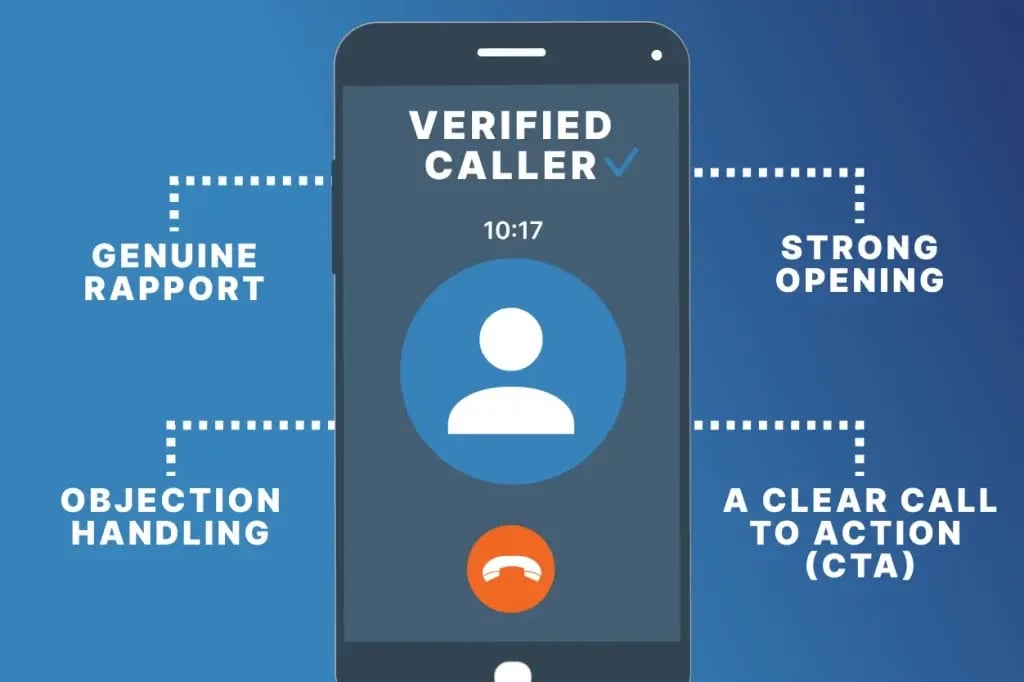
Here’s what you should aim to include in every cold call:
Strong Opening
Start the conversation by explaining why you’re calling and by mentioning a specific property detail or life event that captures the prospect’s attention. The goal is to keep them on the phone.
Genuine Rapport
Establish a genuine rapport by asking permission to talk, then actively listening and asking open-ended questions. Try to discover their expectations and whether your offer is a good fit.
Objection Handling
Respond to any pushback with empathy and a tailored value proposition instead of accepting rejection. For example, if they say they’re not interested right now, offer to follow up in a week. Whatever you do, be polite and respectful of their decision.
A Clear Call to Action (CTA)
Close with a specific call to action (CTA) so prospects know what to do next. That could mean buying your service or simply scheduling a follow-up call.
How to Train Outbound Call Agents in the Age of AI
Now that you understand the role that AI plays in dialing campaigns and what a successful cold call includes, here’s how to train your team:
Teach the Fundamentals First, AI Second
Ground new agents in the core cold calling skills (covered above) before introducing any AI tools, so they learn basic cold calling skills without relying on AI.
Use AI for Role-Playing
AI-simulated conversations can let agents rehearse difficult scenarios (angry prospects, tough objections, etc.) in a low-stakes setting before facing real calls.
Analyze Call Recordings With AI
AI can flag patterns such as talk-to-listen ratios, filler words, or where calls tend to fall apart, giving you concrete data to coach against rather than relying on your intuition.
Set Clear Boundaries for AI’s Role
Make clear which parts of the dialing workflow are AI-assisted (research, follow-up tracking, scheduling, etc.) versus fully human (the live conversation), so agents don’t over-delegate to AI.
Emphasize Emotional Intelligence
Since empathy is the piece AI can’t fully replicate, coach agents on how to read tone, adapt to a prospect’s emotional state, and build trust quickly.
BatchDialer’s AI Tools
BatchDialer comes with built-in AI tools to help streamline your dialing workflow. They include:
- Real-Time Call Guidance: Receive live prompts on what to say during calls to improve communication. While you shouldn’t rely on it for every word, it can help you when stuck.
- Automatic Call Results: Calls are automatically labeled based on the conversation outcome. That way, you don’t need to manually mark conversations.
- AI-Generated Call Summaries: Get instant summaries of your calls for easy reference later. Review them with your team to see where there’s room for improvement.
Try BatchDialer Today for Free
Ultimately, the best dialing campaigns combine AI with human interactions. If you use only one or the other, you may be leaving money on the table due to lost leads or low productivity.
Ready to start implementing AI into your workflow where it can really make a difference? Try BatchDialer. Its AI tools can help you keep up with leads at every point in their customer journey.
Start your 7-day free trial of BatchDialer now!
Frequently Asked Questions (FAQs)
Why is human connection still important in sales, even with AI available?
Human connection in sales builds customer trust and rapport that AI can’t fully replicate. While AI can handle data and logistics, relationships depend on genuine empathy and emotional intelligence, qualities that make prospects feel understood.
How is AI used in outbound calling today?
AI in outbound calling typically supports the process rather than replacing it. Think prospect research, AI call summaries, and AI call coaching.
Can AI replace call center agents entirely?
No. While AI can manage repetitive or data-heavy tasks, call center agents are still essential for outbound sales conversations that require active listening, adapting to tone, and building customer trust.
Which outbound sales skills matter most in the age of AI?
Core outbound sales skills like active listening, objection handling, and relationship building remain just as important as ever. AI can support these skills with better prep and coaching, but it can’t substitute for an agent’s ability to read a prospect’s emotional state in real time.
How can AI improve sales productivity without hurting customer engagement?
By automating time-consuming tasks like call tracking, labeling, and summarization, AI frees up agents to focus on actual conversations and less admin work.
What’s the biggest risk of relying too heavily on AI in outbound sales?
Over-relying on AI can erode the human connection in sales that drives customer trust. Prospects can often tell when they’re talking to a human or an AI agent. The latter can feel impersonal and hurt your conversion rates.